AI
New to Code? Don't Skip the Boring Part
Advice for undergrads in the age of AI — learn one language properly before you lean on the machine.
Back in my early working days, I spent a lot of time mentoring students. There was the C Club — a community of around 3,000 college kids spread across the country — and later Navgurukul (navgurukul.org), where we prepared kids without a college degree straight up for jobs. Helping people get job-ready was something I did a lot of, and I figured I had a decent feel for it.
Then I went heads-down for a while and didn't interact with many new learners. Over the last two or three weeks, a handful of undergrads — some early in their degree, some fresh out of college — reached out asking what they should do. And I'll be honest: I was taken aback. The AI shift was so big it took me a moment to even reframe the question. Wait — what's the process for becoming market-ready these days?
This is what I've landed on, for now.
My short answer: learn the basics first. AI comes after.
I know that sounds backwards in 2026. Why grind through fundamentals when a model can write the code for you? Because the model writing code for you is exactly why you need the fundamentals. If you can't read what it produces, can't tell good from bad, can't debug it when it breaks — you're not in control. You're just hoping.
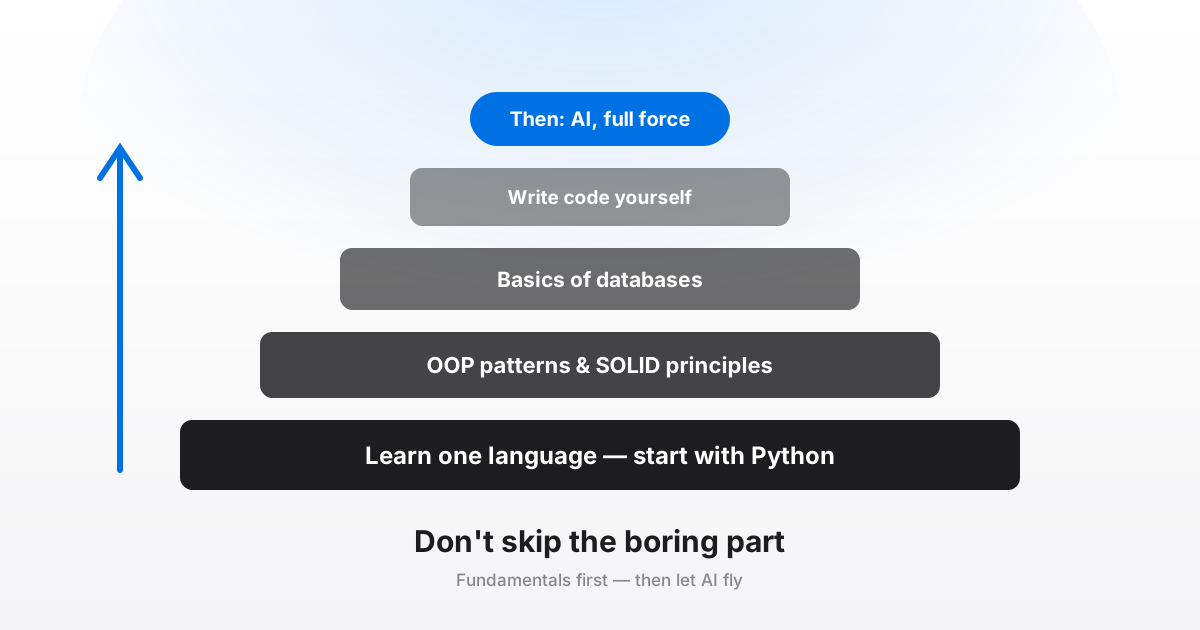
Start with one language. Learn Python before C++. Python gets out of your way and lets you focus on the actual ideas — variables, loops, functions, data structures — instead of fighting pointers and memory on day one. Pick one language and get genuinely comfortable in it.
And this matters no matter where you're headed. Data analytics? Machine learning? Whatever's hot this year? Pick a language and learn it first. All of it is built on writing code — without that foundation, you're learning the roof before the walls.
Then write code yourself. By hand. Make the mistakes. Hit the bugs and sit with them until you understand why they happened. This is the part people want to skip now, and it's the part that matters most. Once you've struggled through it yourself, AI becomes a multiplier instead of a crutch — because you can actually judge what it gives you.
Build the base before you build on top of it. Know the SOLID principles. Understand object-oriented patterns. Learn the basics of databases — how data is stored, queried, related. These aren't academic checkboxes; they're the mental models everything else rests on. Once that base is solid, bring in AI tools and watch how much faster you move.
And yes — you can absolutely use AI to learn. Ask it to explain a concept, walk through code, quiz you. That's a great use. The line I'd draw is this: know at least one language properly before you lean on AI to its fullest. Use it to learn the basics, not to skip them.
So wherever you are: if you're in your first year, start now — pick a language and go deep. If you're in your fourth year and job-hunting, make sure you genuinely know at least one language before you let AI do the heavy lifting.
I don't have a neat checklist like the ones I used to hand out years ago. But if there's one thing I'm sure of, it's that the fundamentals didn't stop mattering — they're what lets you actually use AI well. Get them first. The rest comes easier than you'd think.